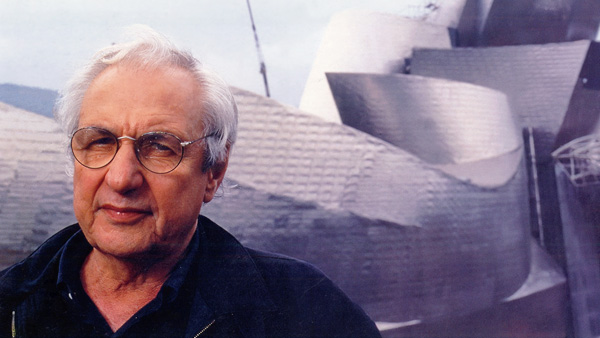

At the age of 96, Frank Owen Gehry died at home in Santa Monica on Friday 5 December. The most popular American architect since Frank Lloyd Wright, who marked a turning point in the art of building with his Guggenheim Bilbao, has been eulogized in the media as a titan (The New York Times) or a giant (El País), and it is not here that his stature will be belittled. His sculptural and choreographic buildings have defined a whole period, and these magazines have followed his creative journey with fascination and curiosity. In 1986 I described him as “a wild replica, in galvanized metal, of the refined neoconstructivist calligraphies,” surely with the energetic, chaotic renovation of his house in mind, and in 1988 Arquitectura Viva put him on the cover of its maiden issue, illustrating the MoMA’s influential exhibition on deconstruction architectures. Two years later, coinciding with a stint at the Getty that allowed me to become acquainted with his person and his work, AV made him the subject of a monograph, and another couple of years later, making an exception in its rule of putting only built works on its cover, Arquitectura Viva decided to show his extraordinary proposal for Bilbao, the most ambitious museum project then underway. Upon its completion in 1997, we devoted an entire Arquitectura Viva to him, something we had never done before and have never again since, and the importance of this Guggenheim for the profession and for Spain explains the 2021 book compiling all my articles on the Californian architect.
Titled Gehry, artista e icono, it summed up his creative profile and historical impact using those two terms. ‘Artista’ for two reasons: because his already mature-stage passage from a conventional professional practice (in an early phase working for Victor Gruen, inventor of suburban shopping malls, and since 1962 on his own) to what made him famous took place through the influence of his psychoanalyst and of the art world he was friendly with; and because his projects thereafter became choreographic, born of a tangle of lines that seem to imitate the movement of a dancer, and sculptural, carved from the model out of a desire to create recognizable forms. And ‘icono’ likewise for two reasons: the emblematic nature of the buildings, which come across as memorable objects; and that of their own authors, who become acclaimed figures tagged as star architects, whom Gehry himself exemplified when he appeared as a character in the saga of The Simpsons, perhaps the highest indication of fame in the American imaginary. This recognition came to him two decades ago, eight years after finishing Guggenheim Bilbao, when he was about to start work on what would be his three final big projects: a residential skyscraper in Manhattan, 8 Spruce Street, which would open in 2011; the Fondation Louis Vuitton in Paris, inaugurated in 2014; and Guggenheim Abu Dhabi, a museum of art in the Emirates, to be completed in 2026 as the largest outpost of the New York institution.
Though Gehry first became known with his own house in 1978, and though it was then that he began his ‘artistic’ career through fragmented buildings with a touch of pop – an influence of Rauschenberg and Oldenburg – his true annus mirabilis was 1989, with the opening of a universally applauded small museum on the Vitra campus, and his winning of the Pritzker Prize. That year also saw him wrap up the Schnabel House, an exquisite residence in Brentwood that Philip Johnson wished to visit in 1990; Gehry then was so kind to set up a joint tour, giving me the chance to meet the legendary master, whom I would thereafter deal with more regularly through Peter Eisenman in New York and New Canaan. In 1991, Johnson curated the United States pavilion at the Venice Biennale, and focused the exhibition precisely on Eisenman and Gehry, presenting the latter’s scheme for the Walt Disney Concert Hall in Los Angeles. The construction of this great building suffered many vicissitudes (it took until 2003 to open), which damaged the reputation of an architect already affected by the extraordinary cost overruns of the American Center in Paris, causing the institution’s disappearance and the building’s sale to the French state, which turned it into the Cinémathèque.
Gehry was rescued from this low moment by the popularity of the dancing Ginger and Fred in Prague, but especially by Guggenheim Bilbao, which thanks to the CATIA program used by the aerospace industry managed to raise its warped titanium shapes within the budget and the deadlines, thereby also saving the skin of Thomas Krens, the Guggenheim Foundation’s then highly questioned director. But a few months before its official opening I was honored to speak on the work at the New York museum, and verified the local establishment’s extreme hostility toward the Californian, who had failed to carry out his own city’s most important cultural project and ruined the US’s best embassy in France. All this by now belongs to the petite histoire of architecture, because in the grand history of this art and this profession, the Frank Gehry – né Ephraim Goldberg – whom I had the privilege of meeting and dealing with – in Los Angeles and New York but also in Bilbao and Madrid – already counts among the leading figures of the period that stretched from the fall of the Berlin Wall to the collapse of Lehman Brothers: a time which was optimistic, cheerful, and theatrical, just like the scenographies of the second great Frank.