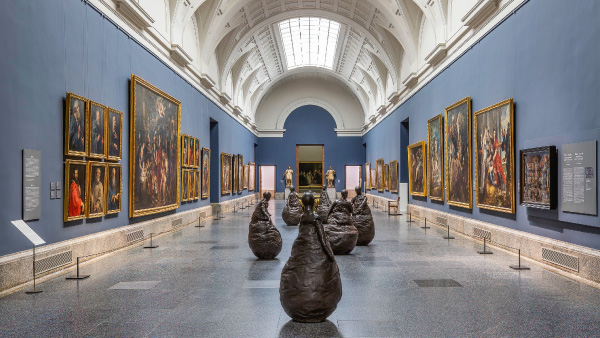
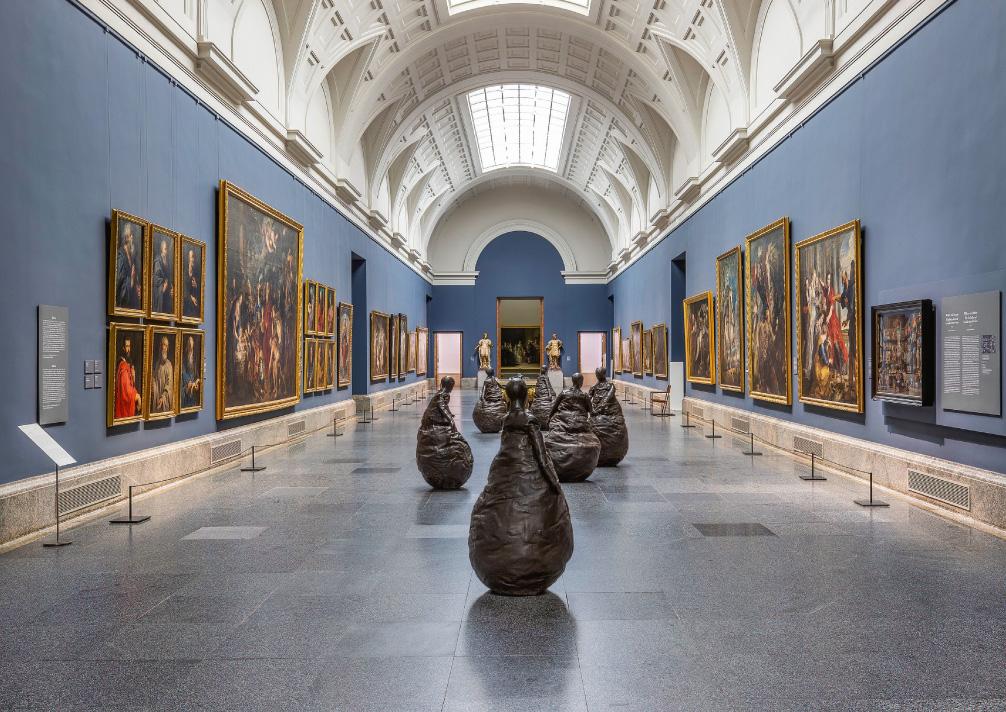
Image of the Main Gallery of the Museo Nacional del Prado with artworks related with the ‘Juan Muñoz. Stories of Art’ exhibition on display. Photo ©Museo Nacional del Prado
From November to March, the Prado Museum is using its two floors of temporary galleries to host monographic exhibitions on Antonio Raphael Mengs (1728–1779) and Juan Muñoz (1953–2001). The painter conventionally labelled Neoclassical is presented in dialogue with the two Renaissance artists chosen by his father to fashion his first name, Antonio Allegri da Correggio and Raphael, and also in dialogue with the scholar and archaeologist Johann Joachim Winckelmann, who, together with Mengs, promoted the adoption of classical Antiquity as a model for all the arts. The contemporary sculptor, for his part, is exhibited in dialogue with the Prado masterpieces he studied closely and which inspired his own work, since in addition to the upper temporary gallery his pieces are installed in a Central Gallery now renewed in an intense blue, in the room of Las Meninas and even outdoors, flanking the path that leads to the Jerónimos entrance. It may be, however, that the most interesting dialogue is the one ultimately established between these two figures, separated by more than two centuries and brought together by the museum in a forced coexistence in space and time.
Curated by Andrés Úbeda and Javier Jordán, the Mengs exhibition is didactic, for it adequately covers the full work and thought of the artist born in Bohemia and trained in Dresden and Rome, with admirable canvases such as the 1760 Self-portrait belonging to the House of Alba or the 1772 Portrait of Isabel de Parreño on loan from the Academy of Fine Arts, and such singular pieces as Jupiter and Ganymede from the Palazzo Barberini, the fake Roman painting by Mengs that deceived Winckelmann and ruined their friendship. But much of what is shown, including a great deal of religious painting and the portraits of the royal family and court of Charles III, pales beside the works presented as inspiring references, whether Giulio Romano working with Raphael or Correggio’s marvelous canvas, which the display singles out on a visual axis. In the end, the exhibition does nothing to increase the artistic stature of someone so influential in the 18th century, and important for Spain through his protection of Francisco Bayeu, and hence of Goya, and through the writings devotedly published by José Nicolás de Azara. Though he sought to be the first Neoclassicist, it may well be that he was in fact the last Baroque painter, and it is hard to dissent from Goethe’s categorical verdict: “His erudition was coupled with a lack of initiative and a poverty of invention, giving rise to an artificial, forced mannerism.” But the poet, as we know, reserved his true admiration for Winckelmann.
By contrast, the Juan Muñoz exhibition, which its curator Vicente Todolí has titled Historias de Arte (Stories of Art), offers a truly provocative and suggestive journey through the career of the prematurely deceased Madrid artist. Neither in the rooms devoted to him nor in the other spaces of the museum is there a single piece or ensemble that feels superfluous or fails to invite serious reflection, with the possible exception of the drawings or the four vitrines in the guise of a “cabinet of curiosities”; and perhaps the dialogue proposed with the works of Velázquez and Goya is more media-friendly than indispensable, since the Conversation Piece in the Central Gallery would be overwhelming anywhere, and Thirteen Laughing at Each Other does not require the immediacy of Old Master paintings to provoke bewilderment, curiosity, or intrigue. Exaggeratedly Baroque and theatrical, with an abundance of ‘optical floors’ whose illusory, ornamental geometry has turned them into stars of the merchandising, the installation leads us from room to room on an itinerary of joyful discovery, from the seated figures to the one hanging by a foot, and from the balconies to the conversational scene surrounded by curtains. The models for the characters inhabiting these stages range from the Art Nouveau bust that is repeated in the Chinese figures or the Egyptian sculpture with a broken nose that serves for the acrobats to the people with achondroplasia Jorge/George and Sara, who appear in the prompter’s-box installation or at the billiard table before Las Meninas, but it may be that the true models are to be found instead in the artist’s highly pertinent library, an exact collection of books displayed as an interpretive coda to this dazzling exhibition.
The genuine dialogue at the Prado during these five months, however, will not be between Mengs and Raphael or between Muñoz and Velázquez, but between an 18th-century painter and a 20th-century sculptor, and it will be less an amiable conversation piece between artists than a tenacious competition to capture the gaze and emotion of visitors. It is a struggle that cannot be decided solely by media attention or the popularity of exhibitions, dissolved as they are into the museum’s general flow, nor is it a new version of the Renaissance paragone that sought to determine the superiority of painting or sculpture. It is an unequal fight, like the one that the Leoni sculptures now placed in the Central Gallery have won over the 19th-century sculpture that has replaced them in the Jerónimos Cloister, an arm-wrestling for reputation and for history, and the viewer signing these lines has no doubt about the outcome.

Jupiter and Ganymede. Anton Raphael Mengs. Galleria Nazionale d’Arte Antica, Palazzo Barberini, 1339