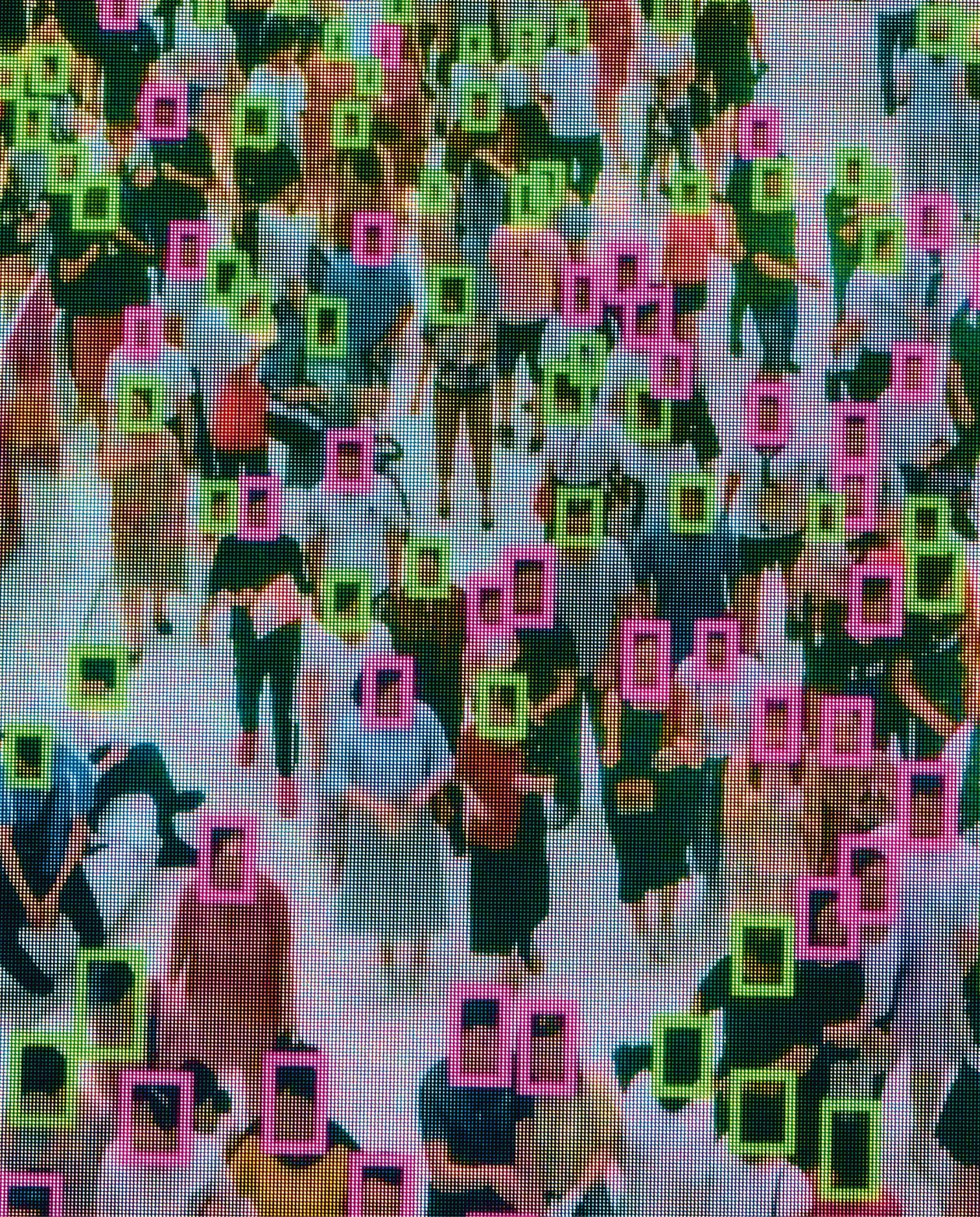
Demonstration of facial recognition technology at the World Artificial Intelligence Conference, Shanghai, China © Qilai Shen / Bloomberg
The two superpowers are already digital autocracies. The Chinese authoritarian model, which avoids the electoral cycles of liberal democracies, and which builds safe cities by multiplying facial recognition cameras, offers the countries of the Global South a path for development through the Digital Silk Route, seduces with its advances in robotics or green technologies, and shows the world how innovation is possible without political freedom. And the cultural revolution sparked in the United States by Trump’s second term, supported by tech tycoons, uses disenchantment with democracy to promote a Caesarism that, in tune with ‘dark Enlightenment,’ considers political checks and balances a failed experiment, and asserts his personal power with an exclusivity that equals a change of regime. Lacking in comparable digital prowess, and fragmented in a cluster of voices, Europe sits on the geopolitical margins while it witnesses the rise of populisms that use ‘democratic fatigue’ to call representative systems and regulatory frames into question.
Neoliberal capitalism went into crisis in 2008, but while China still defends economic globalization, free trade, and an international order based on rules and regulating institutions, the United States of Trump has turned its back on the structures it created after World War II, even abandoning some and giving the rival power the opportunity to occupy those spaces. Paradoxically, the Asian country champions the economically orthodox idea that the only constant is change, that cooperation is not a zero-sum game, and that the linear advance over time towards a greater prosperity demands both continuity in the commitments and predictability in policies and alliances; and no less disconcertingly, the American superpower advocates now a return to an imaginary gilded age, understands commerce as a battle of power, and dreams of a circular time able to make the world go back to its years of undisputed leadership, while it moves with unforeseeable randomness and scarce respect for prior agreements or secular allies.
Trump’s mercantilism has often appeared in the statements of the current president, who already forty years ago declared that “Japan is ripping off the US,” the same as he now says of Europe, and who despite being a faux tycoon, bankrupt several times, acted as the quintessential capitalist in the fourteen seasons of The Apprentice. However, he does not understand that capitalism hates uncertainty, that his will is not enough to resuscitate the Rust Belt, and that democracy is not incompatible with American greatness. Meanwhile, China embraces a capitalism in which traditional production factors – land, labor, and capital, besides technology and entrepreneurial capacity – are rounded off with data, understood as an essential resource for the development of AI, and which in this case are especially valuable due to the size of its population and its limited protection, giving it advantage in a digital gigantomachia the outcome of which does not guarantee the triumph of order over chaos, and even less that of liberal democracy over authoritarian populism.[+][+]