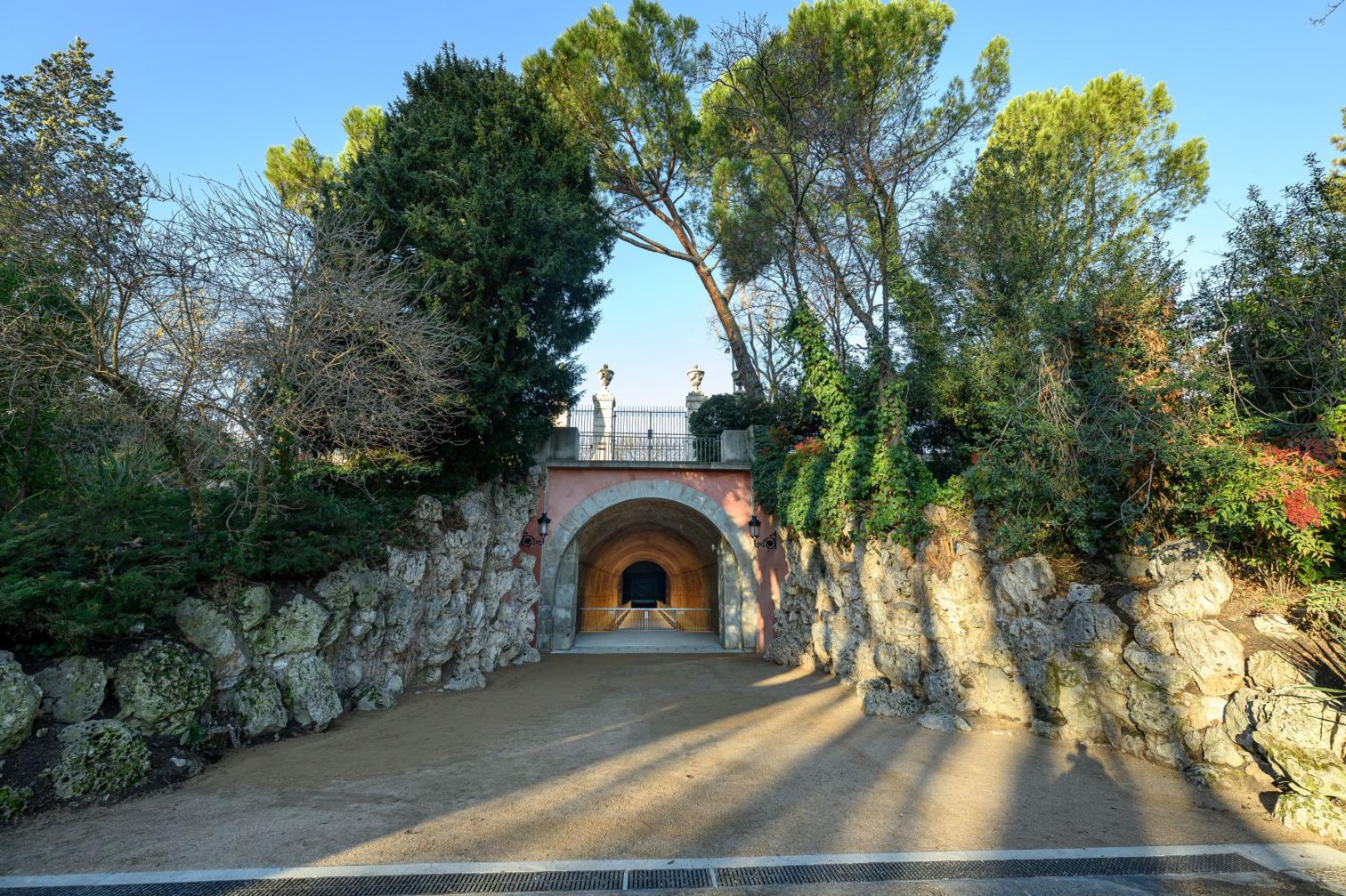
Reopened historic stretch of Villanueva Tunnel

Fotos: Patrimonio Nacional
Following its restoration, the original stretch of the tunnel designed by Juan de Villanueva, in Madrid’s Campo del Moro gardens, has been reopened to the public by Patrimonio Nacional, Spain’s National Heritage organism. It is a unique construction, very simple in form but remarkable in technical and compositional rigor, as is evident in details like its perfect alignment with the axis that extends from the west facade of the Royal Palace.
The so-called Villanueva Tunnel is a vaulted underground passage that Juan de Villanueva designed in 1809, commissioned by José Bonaparte, to serve as a private exit from the Campo del Moro to the Casa de Campo. Bonaparte, however, never used it, as by the time it was completed in 1813 he had left Madrid. Since the 1980s the tunnel has remained closed at both ends – one facing the Campo del Moro and the other connecting to the Casa de Campo.
Recent works in this historic infrastructure have been carried out with a budget exceeding €400,000, provided by the European Union's NextGenerationEU program, and been executed in various areas. The most significant has been the restoration of Villanueva’s original proportions by lowering the existing ground level. The work has verified that the tunnel's section maintains dimensions identical in width and height, a feature which can now be appreciated thanks to the newly installed walkway, which also enables visitors to experience the original ground level.
The electrical, lighting, sanitation, and fire-protection systems have also been updated. And the project has involved the immediate surroundings, particularly the stairs leading to the tunnel from the Paseo de la Virgen del Puerto, as well as the restoration of the entrance facing the Campo del Moro, not to mention the brick and stonework elements inside, where the original traces of the construction are still visible.
When the works on this section managed by the Madrid City Council are completed, the tunnel will be traversable throughout and fully integrated into the urban and landscape fabric of the Madrid Río area, thus altogether reviving the urban complex designed by Juan de Villanueva.