
Federal Style
Three Timber Buildings Across USA
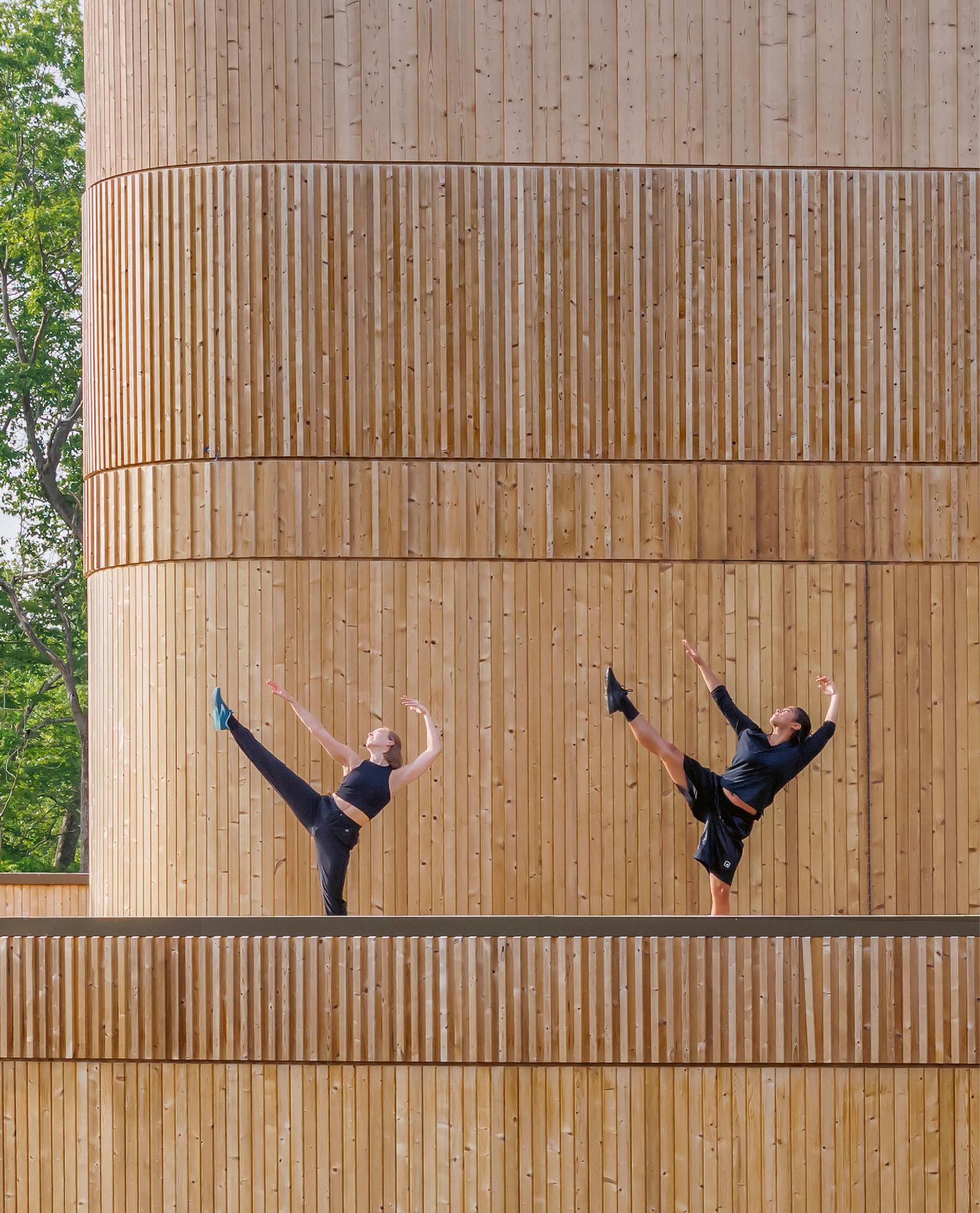
Mecanoo, Doris Duke Theater, Becket, Massachusetts (United States)
Now that in the United States there are those who have posed the ‘need’ to make civic architecture beautiful again through a ‘purely American’ style, the powers-that-be ought to do the exercise of figuring out where lies the essence of a nation that stretches 4,500 kilometers from coast to coast and 2,500 from north to south, home to thousands of ethnic groups. Perhaps only then would they notice that the stone and brick characteristic of Palladian neoclassicism, so much to their liking, are scarce in the Land of the Free, in comparison with wood, which is ubiquitous.
Whether coming from the Appalachian oak woodlands, the Pacific temperate forests, or the southern pine savannas – a densely populated biome that has earned the region the nickname ‘The Wood Basket’ – the material is an integral part of the landscape and cultural history of virtually every state. It was already present in the houses of Chaco Canyon, the teepees of the Great Plains, and the longhouses of Iroquois; later the Pilgrim Fathers, the pioneers of the West, and immigrants from the Old World knew to exploit it. Much of American life has transpired in timber structures – thus we have Uncle Tom’s Cabin, Walden, the House on the Prairie, and other legendary spaces of the national imaginary – and even the steel skyscrapers that symbolize the country owe their existence to the standardization systems achieved in balloon-frame construction.
While today it remains easy and relatively affordable to build a single-family home out of pine or spruce, whether in New York or Nashville, the timber industry faces the technical challenge of making log structures competitive for use in buildings with larger spans and heavier loads, and this has fueled extensive testing with laminates, metal reinforcements, and computer-controlled cutting procedures. Traditional carpentry techniques are also threatened by climate change, not only because of the virulent wildfires that burn the forests from which the raw material is obtained, but also because of the tightened building codes in response to the risk of fire. This presents yet another opportunity for technologies like CLT wood, which offer improved resistance to fire.
Thirty years ago, this magazine announced that wood was back, never having really gone away, and once again we cover the latest applications of a material that nowadays, more than ever before, is asserting its currency by virtue of its low carbon footprint and sustainable management. Here are three student buildings, on different campuses, that demonstrate academia’s eagerness to update techniques: the Anthony Timberlands Center by Grafton Architects for the University of Arkansas; the Bloomberg Student Center by BIG for Johns Hopkins; and the David Rubenstein Treehouse by Studio Gang at Harvard.

De Leon & Primmer Architecture Workshop, Locust Grove Pavilion, Louisville, Kentucky (United States)